Julia Korol
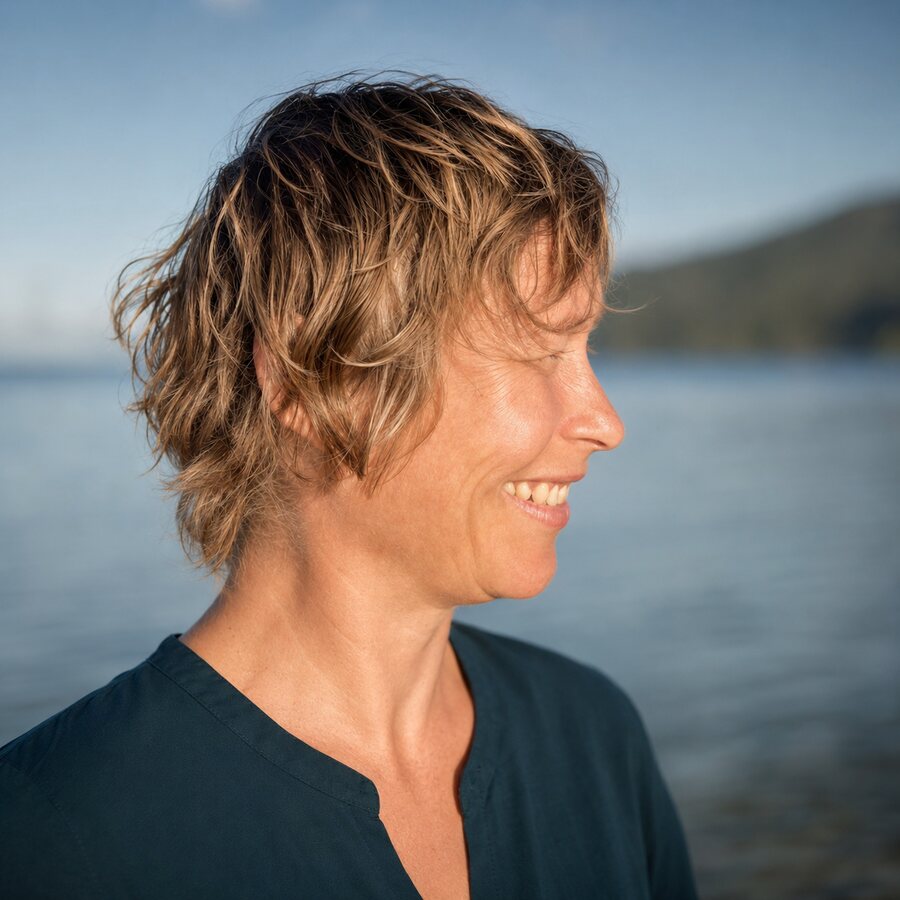
Julia Korol, portrait by the water

Environmental and resource management · water, land use, infrastructure

Julia Korol

Bremen · Amsterdam · Vienna

This is where I present the work and the questions I am occupied with — water, space and ecosystem services, and how technical, ecological and economic perspectives can be brought together.

CurrentlyEnvironmental and Bio-Resource Management (BOKU Vienna) · Sales at HomepageLotse

How I work

What interests me is what an idea can actually become under the concrete conditions of a given site:

  • What are the natural preconditions, and which use makes sense?
  • What infrastructure does it require?
  • Which technical, economic, ecological and institutional conditions have to be thought through together?

My strength lies in understanding how things connect across disciplinary boundaries, bringing different perspectives together, and translating between them in a way people can follow.

About me

I come from Bremen and grew up with water as a self-evident part of the landscape. My grandparents had a house directly on the river. Where a sandy beach and floodplains lay in the 1950s, there is a high flood dyke today. How much landscape, land use and our handling of water can change was something I experienced there early and in very practical terms.

I later lived and worked in the Netherlands for many years. My professional background is commercial to begin with: international customers, sales, production and logistics. During my time at Norit, a Dutch manufacturer of activated carbon, water took on a new, technical dimension for me. Activated carbon is used, among other places, where water quality is decisive — from wastewater treatment to the preparation of drinking water. Water was no longer only part of a landscape, but also a question of quality, limit values, technical processes and reliable operations.

At the Vrije Universiteit Amsterdam a further perspective was added. In the programme Aarde en Economie I worked on water management, land use, flood protection and the question of how natural, technical and economic systems interact. In Vienna I continued along that path with the engineering programme in Environmental and Bio-Resource Management at BOKU — deliberately interdisciplinary, and that is exactly how I like to work.

Today I am particularly occupied with questions around spatial planning and land use, water, environment and infrastructure. I enjoy working my way into new questions, researching, analysing and structuring information. Costs, processes, users and feasibility belong to a project for me just as much as its technical foundations.

At HomepageLotse I work in sales and accompanied the conceptual rework of the web presence. Behind that lies a question I keep meeting in other fields as well: how can something complex be structured and conveyed so that it becomes understandable and usable for others?
Work

Water as part of the site

Site and water concept · Kerames, Crete · 2022–2024 · German

For a small holiday development on the southern slope of the Siderotas mountains on Crete's south coast, I developed the site analysis and the water concept. The guiding question was how tourist use can be fitted into the existing landscape without reshaping its natural structure for standardised construction.

The concept lets water flow by gravity wherever the topography allows, overcoming individual height differences with pumps only at specific points — rather than adapting the terrain to the watercourse. An existing natural inflow is led visibly across the property, guided over terraced water areas, filtered, and then returned to the natural water system. A permanently shaded storage area takes on two opposing tasks: holding water and limiting evaporation through the dry summer, providing additional retention volume through the wet winter. Multi-stage sedimentation protects the pumps and the biotope below from sediment load.

My contributionSite analysis, use concept, water and landscape concept.
StatusEarly concept and development phase. What is shown is not hydraulic, structural or permit-ready engineering; hydrology, water law, subsoil and the technical dimensioning would have required specialised planning.
Water as part of the sitePDF · 6 pages · German

Hidden Streams as Blue-Green Infrastructure

Wienerwaldbäche · Vienna · BOKU · 2021, revised 2026 · English

Can daylighting Vienna's culverted Wienerwaldbäche contribute to a more climate-resilient city? Around 50 of these streams run through Vienna; roughly two thirds are invisible at the surface because historical enclosures moved them into the drainage and sewer network.

The work does not confirm the strong version of its own initial hypothesis: a city-wide cooling effect from exposed streams alone could not be derived from the available evidence. What does hold is the combination of functions — evapotranspiration and shade, stormwater retention, ecological connectivity, water quality and public space. The 2026 revision examines what has become of that planning logic since: not large-scale daylighting, but the institutionalisation of the systems approach in the Smart Klima City Strategy (2022), the Building Code (2023), Wien-Plan 2035 and the GRF Wien assessment tool. The Wienerwald's Flysch zone, with its low infiltration and rapid runoff peaks, makes flood safety a non-negotiable constraint.

My contributionResearch, analysis and text, in 2021 and in the 2026 revision.
StatusLiterature and policy analysis. No own measurements, no microclimate modelling.
Hidden Streams as Blue-Green InfrastructurePDF · 9 pages · English

Economic Valuation of Ecosystem Services Provided by Riparian Buffer Strips

Ecosystem services of riparian buffer strips · BOKU · 2021, revised 2026 · English

How can ecosystem services that carry no market price be made visible in economic decisions? Riparian buffer strips show the distribution problem in its purest form: the costs — land taken out of production, establishment, maintenance — are visibly borne by the farmer, while reduced nutrient input, less erosion and habitat provision act far beyond the farm boundary.

The work compares the common valuation methods — market prices, production function, avoided cost, replacement cost, hedonic pricing, travel cost, contingent valuation, benefit transfer — each with its strength and its limit, and shows why the choice of method co-determines which dimension of value is captured at all. It checks the Ecosystem Services Valuation Database as of 2021 against its 2025 state and places the Austrian agri-environmental framework alongside. The load-bearing interpretation rule: a payment, the farmer's opportunity cost and the social value of a service are three different economic quantities — treating them as interchangeable produces misleading policy conclusions.

My contributionI independently researched and wrote the economic chapter of an interdisciplinary five-person project; the 2026 version is my own revision, in which borrowed figures are replaced by my own.
StatusRevised synthesis, not a new peer-reviewed study.
Economic Valuation of Ecosystem Services Provided by Riparian Buffer StripsPDF · 5 pages · English

Contact